
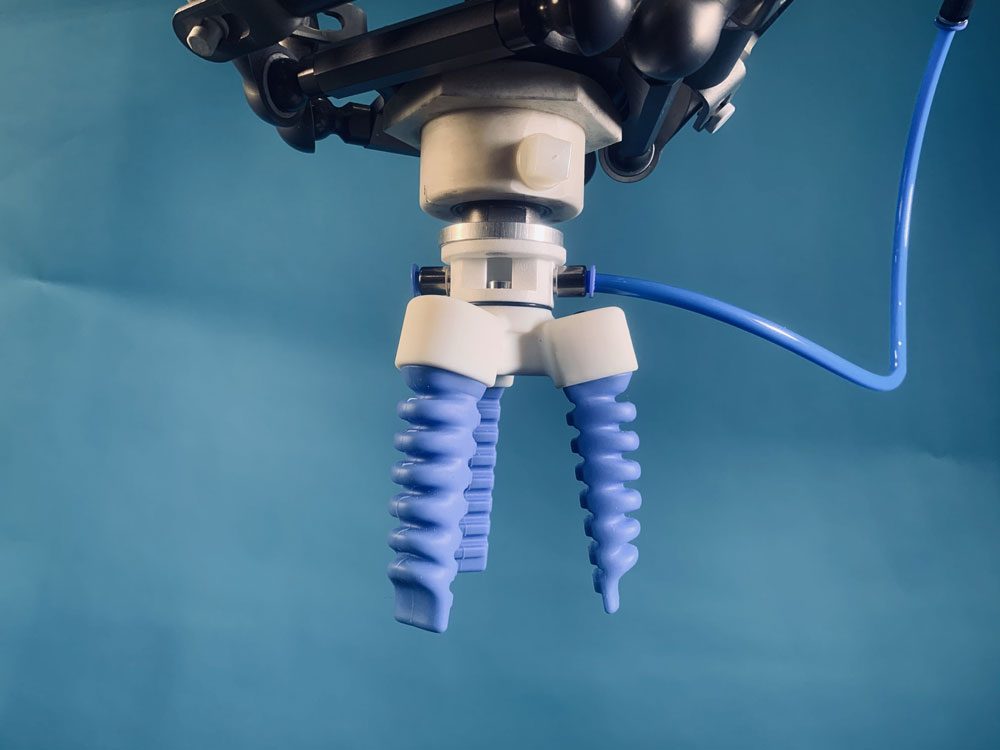
A ripe tomato, a delicate cosmetic container, and a freshly molded plastic component have little in common from a manufacturing perspective. Yet they present a similar challenge for industrial robots: applying enough force to hold the object without damaging its surface or changing its shape. Conventional mechanical grippers can struggle with this balance, particularly when products vary in geometry or respond unpredictably to pressure. Soft robotic gripping approaches the problem differently by using compliant contact surfaces that adapt to the object rather than requiring the object to fit a rigid gripping mechanism.
Why Conventional Grippers Struggle With Delicate Products
Traditional robotic grippers generally use rigid fingers, vacuum suction, or mechanical fixtures to secure objects during handling. These technologies work effectively when products have predictable dimensions, suitable gripping surfaces, and sufficient mechanical strength. Difficulties arise when the workpiece is soft, irregularly shaped, or sensitive to concentrated contact forces.
Consider a packaging line handling delicate baked goods. A rigid gripper may need carefully designed contact surfaces to avoid crushing the product, while a vacuum system may struggle with porous or uneven surfaces. Variations between individual items can further complicate the process because the gripping force suitable for one product may be excessive for another.
Similar challenges occur outside food manufacturing. Pharmaceutical packaging, personal care products, and certain polymer components may require gentle handling to prevent deformation or cosmetic defects. Manufacturers must therefore balance secure gripping against the risk of applying unnecessary pressure.
How Flexible Fingers Adapt to Product Geometry
Soft robotic grippers use compliant materials, such as silicone elastomers, to create contact surfaces that deform around objects. Instead of relying entirely on precisely matched rigid fingers, the gripping elements accommodate some variation in shape and dimensions. This can increase the contact area and distribute gripping forces more evenly.
The mechanical behavior of flexible fingers depends on their material properties and geometry. A softer material may conform more readily to delicate surfaces, but it can also deform excessively under heavier loads. Engineers must therefore consider stiffness, friction, contact pressure, and the expected movement of the workpiece.
Not every soft gripper uses the same actuation method. Some designs rely on pneumatic pressure to bend flexible fingers, while others use electric mechanisms to move compliant gripping elements. Pneumatic systems can offer considerable flexibility, although they require suitable compressed-air equipment and control arrangements.
Electric designs provide an alternative when manufacturers want to avoid an external pneumatic supply. The soft gripper developed by OnRobot uses interchangeable silicone gripping tools and operates without external compressed air. Its specified maximum payload is 2.2 kg, depending on the object’s shape, softness, and surface friction, illustrating why application-specific testing remains essential even with compliant tooling.
Where Soft Gripping Creates New Automation Opportunities
Food handling is one of the clearest applications for flexible robotic gripping. Products such as fruit, confectionery, and certain baked goods can vary significantly in shape and firmness, making conventional gripping difficult. Compliant fingers can accommodate some of these differences while reducing concentrated mechanical pressure.
Food-contact requirements introduce additional considerations. Gripping materials must be appropriate for the intended food and cleaning conditions, and the complete installation must support suitable hygiene practices. A material certified for particular food-contact applications should not automatically be considered suitable for every ingredient or production environment.
Cosmetics manufacturing offers another interesting application. Containers may have curved surfaces, decorative finishes, or relatively thin walls that are vulnerable to visible marks. Flexible gripping elements can support product transfer and packaging operations where maintaining appearance is an important quality requirement.
In pharmaceutical manufacturing, compliant handling may be useful for suitable containers and packaging components. However, material compatibility, cleaning validation, and contamination control must be evaluated according to the specific process. Soft gripping alone does not establish that an automated system meets pharmaceutical production requirements.
The Engineering Limits of Compliant Materials
Soft gripping provides adaptability, but it also introduces mechanical limitations that manufacturers must understand. Flexible materials can deform under load, potentially allowing heavier objects to shift during acceleration or rotation. The robot’s programmed movement must therefore account for the gripping system’s actual holding capability.
Surface friction is another critical factor. An object with a dry, textured surface may remain secure under relatively low gripping force, while a smooth or oily component could slip under otherwise identical conditions. Testing should reflect the actual surface conditions encountered during production.
Material durability can also influence operating costs. Silicone and other elastomers may experience wear, cuts, permanent deformation, or changes in properties after repeated use. Exposure to cleaning chemicals, oils, elevated temperatures, or ultraviolet radiation can further affect performance depending on the material formulation.
Precision is a separate concern. Because compliant fingers deform around the workpiece, the object’s final position may be less predictable than when using rigid, geometry-matched tooling. Applications requiring very accurate insertion or alignment may need additional fixtures, sensors, or a separate positioning stage.
Product Variation and the Economics of Flexible Handling
The financial value of soft gripping often depends on how many product variations a single tool can accommodate. A rigid gripper designed for one geometry may require replacement fingers when dimensions change. A compliant gripper may handle several related products without extensive mechanical modifications, potentially reducing changeover time.
This flexibility should not be confused with universal compatibility. Products with substantially different weights, dimensions, or surface properties may still require alternative gripping tools. Manufacturers should define a realistic operating range rather than assuming that one flexible gripper can handle an entire product portfolio.
Production speed also affects the economic calculation. A gripping system that handles delicate objects successfully at moderate acceleration may experience slipping or deformation when the robot moves faster. The achievable cycle time must therefore be established through testing rather than inferred from the robot’s maximum movement speed.
Maintenance requirements deserve similar attention. Replaceable flexible fingers may simplify certain repairs, but they also introduce consumable components whose service life depends on operating conditions. Evaluating replacement intervals alongside scrap reduction and changeover savings provides a more complete picture of operating costs.
Why Contact Mechanics Will Shape Future Handling Systems
The development of soft robotic gripping reflects a broader shift in automation design. Rather than relying exclusively on precise positioning and rigid mechanical constraints, engineers can use material compliance to accommodate controlled variation in the products being handled. This approach is particularly relevant where natural or flexible objects cannot be manufactured to identical dimensions.
Future improvements may involve combining compliant gripping elements with tactile sensing and more sophisticated force control. Such systems could potentially recognize changes in contact conditions and adjust gripping behavior during operation. However, greater sensing capability also introduces additional cost, calibration requirements, and software complexity.
The most practical applications will continue to depend on a careful understanding of contact mechanics. Material flexibility can reduce handling difficulties, but it cannot replace proper gripping-force calculations, durability testing, or reliable product presentation. Soft robotic gripping is most effective when compliance is treated as an engineering characteristic to be controlled rather than a universal solution for delicate products.